Ceramic Blanket vs LRB Mattress: Which Insulation is Right for You?
Both are popular for industrial insulation, but they serve very different purposes. Here's a clear comparison to help you specify the right one.
Ceramic fiber blanket and LRB (layered refractory blanket) mattress both appear in insulation specifications, and both are used in similar plant zones. But they are designed for different service conditions, and choosing wrong leads to short service life.
Ceramic Fiber Blanket
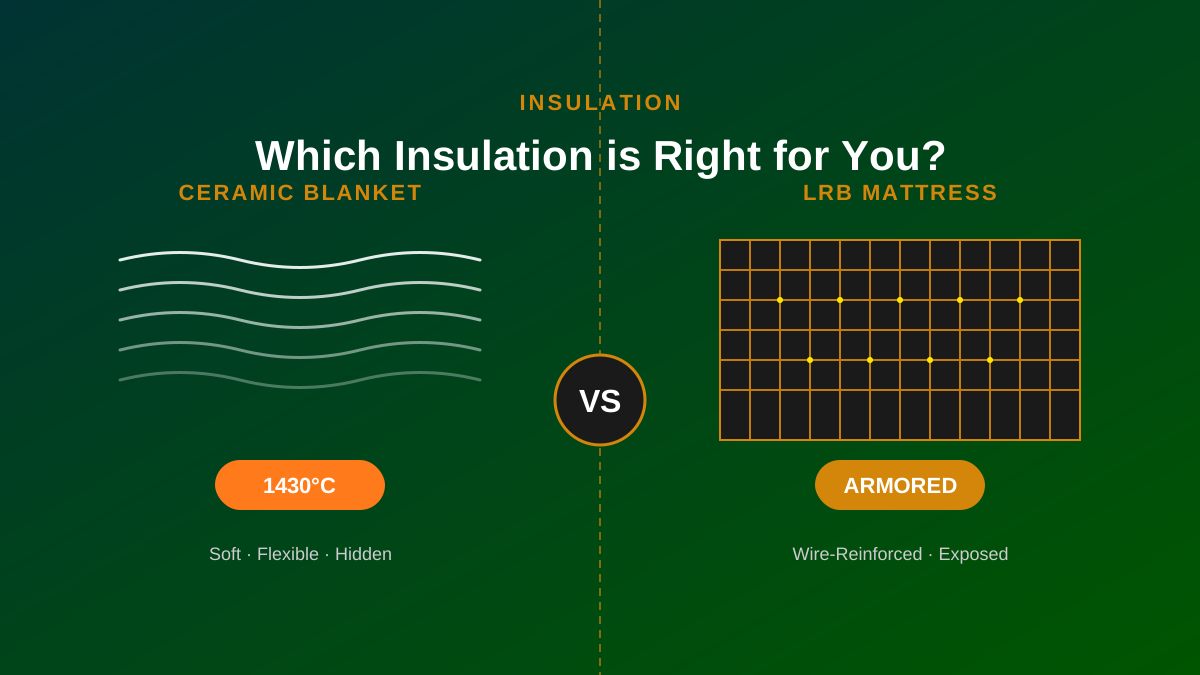
Ceramic blanket is a flexible, lightweight insulation made from alumina-silica fibers. It is soft, easy to cut, conforms to irregular shapes, and is available in 96 kg/m³ to 160 kg/m³ densities with temperature ratings up to 1430°C.
Best for: back-up insulation behind hot-face castable, expansion joint filling, pipe insulation, and any application where gas velocity is low and the blanket is protected from mechanical abrasion.
LRB Mattress
LRB mattress is ceramic fiber blanket stitched between layers of stainless steel wire mesh. The mesh protects the fiber from erosion and vibration, and provides a hard-wearing surface that can be anchored directly to boiler walls and duct sheets.
Best for: penthouse walls, duct liners, high-velocity gas zones, and any application where the insulation is exposed to gas flow, foot traffic, or vibration.
The Core Difference
Blanket is a soft insulator meant to be protected. LRB mattress is an armored insulator meant to face service directly. If your specification requires exposed insulation with mechanical robustness, LRB is almost always the right choice.
Cost Consideration
LRB mattress is 2–3x the cost of equivalent thickness ceramic blanket per square meter. For hidden back-up layers, that cost premium is not justified. For exposed service zones, it is the difference between a 10-year life and a 1-year life.
Practical Advice
We supply and install both products across India. If you are not sure which to specify for a particular zone, send us your drawings and we will recommend the right combination — often, plants use both in different areas of the same boiler.